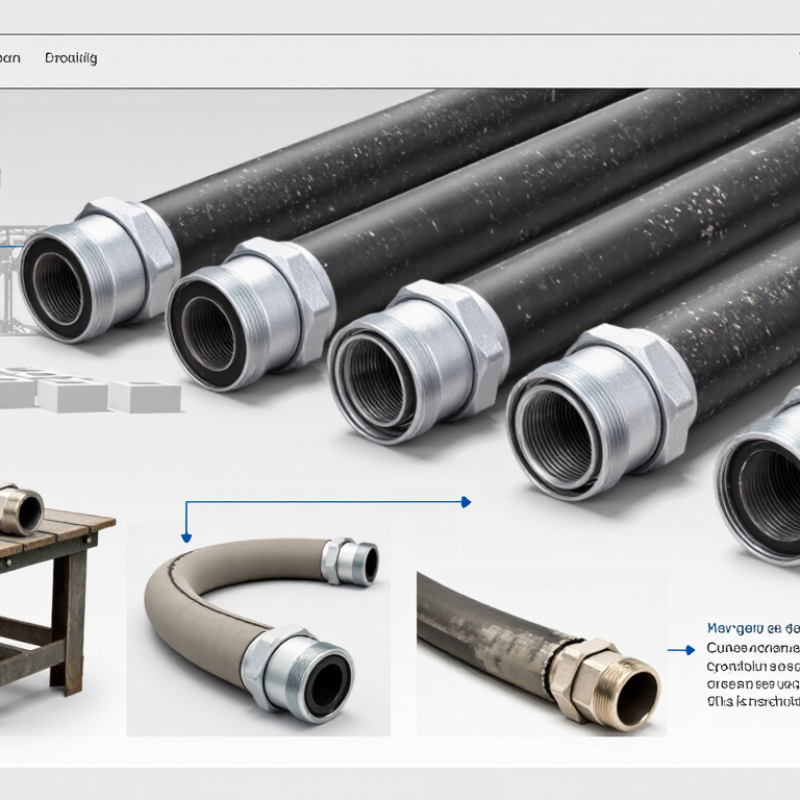
| Product definition | Flexible rubber hose designed to convey cement, mortar, grout, concrete mixtures, or other abrasive mineral materials. | Usually supplied with abrasion-resistant inner tubes and reinforced pressure or suction constructions. | Cement particles can rapidly wear unsuitable hose linings during continuous conveying and pumping. |
| Primary applications | Pneumatic cement transfer, concrete pumping, shotcrete, grout injection, silo discharge, and bulk-material loading. | Application-specific hose construction is required; dry-powder conveying and wet concrete pumping are not interchangeable duties. | Correct application matching reduces blockage, premature failure, material loss, and unplanned shutdowns. |
| Inner-tube material | Abrasion-resistant rubber compound compatible with alkaline cementitious materials and the conveyed medium. | Common compound families include natural rubber, styrene-butadiene rubber, and blends selected for abrasion resistance. | The inner tube is the main wear surface and strongly influences service life and maintenance frequency. |
| Reinforcement construction | Textile, wire-braid, spiral-wire, or steel-cord reinforcement selected according to pressure, bending, and suction loads. | Pressure, suction, and discharge hoses require different reinforcement designs; construction should be verified on the technical datasheet. | Incorrect reinforcement can cause kinking, collapse, burst failure, or excessive bending fatigue. |
| Nominal bore selection | Bore must match the conveying equipment, flow rate, particle size, and connection diameter. | Common industrial hose bores include approximately 25–203 mm, with larger sizes available for specialized conveying systems. | An undersized bore increases pressure drop and velocity, while an oversized bore may reduce conveying efficiency. |
| Working-pressure verification | The stated working pressure must exceed the maximum operating pressure, including transient pressure surges. | Industrial cement and concrete hoses are commonly specified from low-pressure transfer duty to high-pressure pumping duty; the exact rating is product-specific. | Pressure ratings cannot be inferred from appearance, bore size, or reinforcement count alone. |
| Temperature capability | The hose must tolerate the temperature of the conveyed material, ambient conditions, and cleaning process. | Many general-purpose rubber hoses operate near −40°C to +80°C, while the allowable range varies by compound and construction. | Temperature outside the rated range accelerates hardening, softening, cracking, and loss of pressure capability. |
| Abrasion-performance evidence | Supplier should provide compound information and test documentation for abrasive service. | ISO 4649 is commonly used to determine abrasion resistance of vulcanized or thermoplastic rubber; test results should be compared using the same method. | Standardized test evidence provides a more reliable comparison than unsupported claims such as “heavy duty.” |
| Dimensional and pressure documentation | Technical documents should state bore, outside diameter, minimum bend radius, working pressure, test pressure, and temperature range. | ISO 1307 is an established reference for rubber and plastics hoses, including nominal bore and dimensional tolerances. | Complete documentation supports safe installation, interchangeability checks, and preventive maintenance. |
| Connection compatibility | Ends must match the equipment using suitable flanges, threaded couplings, cam-and-groove fittings, quick couplings, or victaulic-style connections. | Connection type, gasket material, clamp design, and locking method must be specified for the operating pressure and medium. | Connection failures can create serious safety risks even when the hose body is correctly rated. |
| Static-control requirements | Electrically conductive or antistatic construction may be needed for dry-powder conveying systems. | Electrical resistance and continuity should be stated and verified according to the selected hose specification and site safety requirements. | Static accumulation may damage equipment or create ignition hazards where combustible dust is present. |
| Quality and traceability | Each hose should be identifiable by production batch, manufacturing date, specification, and pressure rating. | Preferred supplier documentation includes inspection records, conformity declarations, material information, and installation guidance. | Traceability supports audits, warranty claims, failure analysis, and consistent replacement purchasing. |
| Supplier selection priority | Select suppliers based on verified technical conformity, application experience, delivery capability, and after-sales support rather than price alone. | A robust procurement scorecard should assess abrasion resistance, pressure rating, bend radius, connection quality, documentation, lead time, and lifecycle cost. | Global cement production requires dependable hose supply for continuous quarrying, grinding, transport, batching, and construction operations. |